NEWEST: Goddesses blog examines "People of the Lie"
|
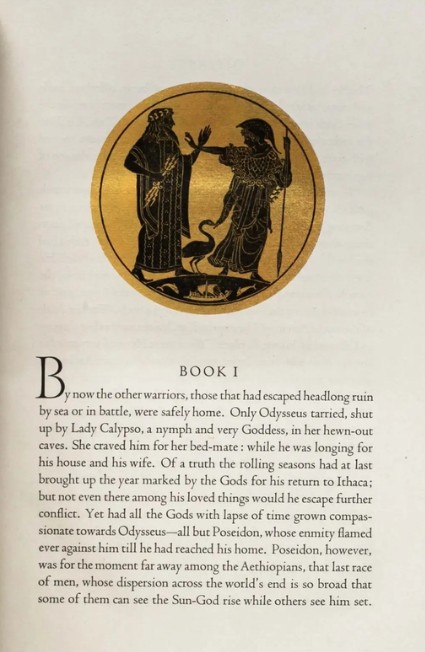
Many are the goddesses within The Odyssey. Starting somewhere in the middle, Penelope, the mortal leading lady in the three thousand year old saga, speaks of Earth as Mother Earth: "the gods have given each thing its place in the life of mortal men on mother earth." Mother Earth being mentioned in so matter of fact a manner by Penelope points to the significance of how Earth, she, who the Greeks called Gaia, was understood by people three millennia ago. Consider before we snooze along some interesting goddess references related to sleep in The Odyssey. Penelope can't get to sleep: "until Athena cast a deep sleep on her eyelids. While she spoke, her eyelids drooped in sleep, and the goddess returned to Olympos." Another time, Athena stands by sleepless mortal male hero, Odysseus, and says: "Come, come, sleep away. All this watching and waking tires a man out." Once, as Odysseus sleeps, his wife Penelope wakes and begins praying: "Artemis, queen and goddess, daughter of Zeus..." The Odyssey also offers old Greek puns. It is fun to read Odysseus saying of himself: "I know that Poseidon [Earthshaker] has an odd dislike for Odysseus." Also enjoyable is when The White Sea Goddess, Ino, says of Odysseus: "You're odd-I-see, true to your name!" And remember this, as The Odyssey will remind several times, Odysseus is a man who is never at a loss. Wise goddess Athena is the hero's biggest fan. She goes to bat for him on Mount Olympus. She also appears and leads him forward in the narrative, giving him detailed route guidance: "At the head of this harbor is an olive tree covered with its long leaves, and near the tree is a beautiful dusky cave, sacred to the nymphs who are called Naiads. It has two doors, one turned to the north, by which mortal men may descend, one on the south, meant rather for gods, by which men do not enter, but this is the road of the immortals." Here, Athena describes Odysseus as storyteller: "A cunning rogue he would be, master of craft, who would outwit you! Even a god couldn't do it. Irrepressible! Everlasting schemer! Indefatigable fabulist! Even in your own country you wouldn't desist from your tales and your historiological inventions, which you love from the bottom of your heart. But no more of this. We are both clever enough. You are the paragon of mankind at planning and storytelling, and I have a name among the gods for cleverness and intelligence." Athena disperses into mist, and Odysseus is before the cave of the nymphs, the naiads. Odysseus says: "Naiad nymphs, O daughters of Zeus, I thought I was never again to see you, but now accept my greeting and my loving prayers." A bit later, Athena calls Odysseus by his full name, Prince Odysseus Laertiades and says: "you are a man never baffled? Athena also calls Odysseus: "prince never unready." Yet he is not ready to start up a new relationship on the fertile island home of the nymph goddesses Calypso. She had nabbed human Odysseus as husband material, but he was not ready to give her his heart. |
|
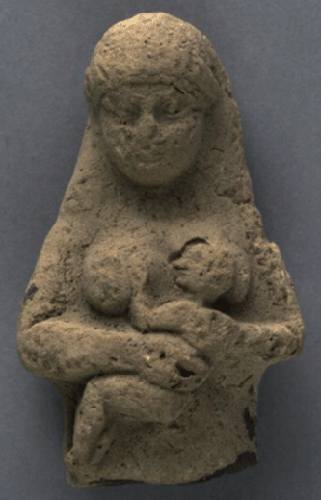
The beautiful goddess smiled and stroked [Odysseus] with her hand saying: "Ah, you are a wicked man! Always wide awake! Or you would never have thought of such a thing. Now then: I swear by heaven above and by earth beneath and the pouring force of [River] Styx, that is most awful [awesome] oath of the blessed gods: I will work no secret mischief against you...I will be as careful for you as I should be for myself in the same need. I know what is fair and right, my heart is not made of iron." Calypso also calls Prince Odysseus Laertiades as she says, "if you knew what troubles you will have before you get to Ithaca, you would stay where you are and keep this house with me, and be immortal...Is she prettier than me? I think not. I don't think it likely that a mortal woman would set herself up as a model of beauty against a goddess." Odysseus knew what to say to that, and he answered at once: "Gracious goddess, don't be cross with me!..." As he spoke, the sun went down and darkness came; and the two lay down in the corner of the lofty cave, and enjoyed their love together. Calypso gives him a good handy axe of bronze, double-edged. [The double bladed axe makes many appearances in prehistoric Mediterranian (goddess centered) cultures back through the Copper Age, also known as the Neolithic Age, or new stone age, especially on the island of Crete.] Five days later, Calypso bathed him and clothed him in garments scented with juniper and sent him on his way on a raft she had provisioned for him. "She did not forget a skin of red wine, and other large one full of water, with provisions in a bag, tasty stuff and plenty of it and she sent him a fair wind, friendly and warm." Odysseus then sits sleepless at his stern-oar steering by the stars like a knowledgeable navigator: "He watched the Pleiades and the late-setting Wagoner, and the Bear, or the Wagon, as some call it, which wheels round and round where it is, watching Orion, and alone of them all never takes a bath in the Ocean." Calypso had warned him to keep the Bear on his left hand as he sailed over the sea. Now hold onto your stern-oar here, readers. Though the proto-hero here is simply trying to get to Ithica, his home island along the coast of Greece, that stellar guidance is an accurate way to navigate the route west from Europe out across the Atlantic with favorable winds and current to arrive at the continents to become known as the Americas. Scholars have suggested that this guidance from a nymph goddess in The Odyssey codifies a prehistoric knowledge about how to travel the Atlantic. The Homeric epic was already an adaptation of earlier tales. According to a translator of the story, Emily Wilson, "the poem used a relatively new technology - the written alphabet - to rework existing mythical traditions." Perhaps the most interesting aspects of this rework, into what T.E. Lawrence called the first European novel, with its hero guided by chatty goddesses home to his goddess-aware wife, are those elements seemingly captured in amber within its ambling from ancient Neolithic notions of a divine Mother Earth. |
|---|

3D VIEWS Explore models of prehistoric palaces Knossos and Malia on the isle of Crete that are offered at Trimble 3D Warehouse created by designers utilizing SketchUp. Track loading by viewing gray bar growth. 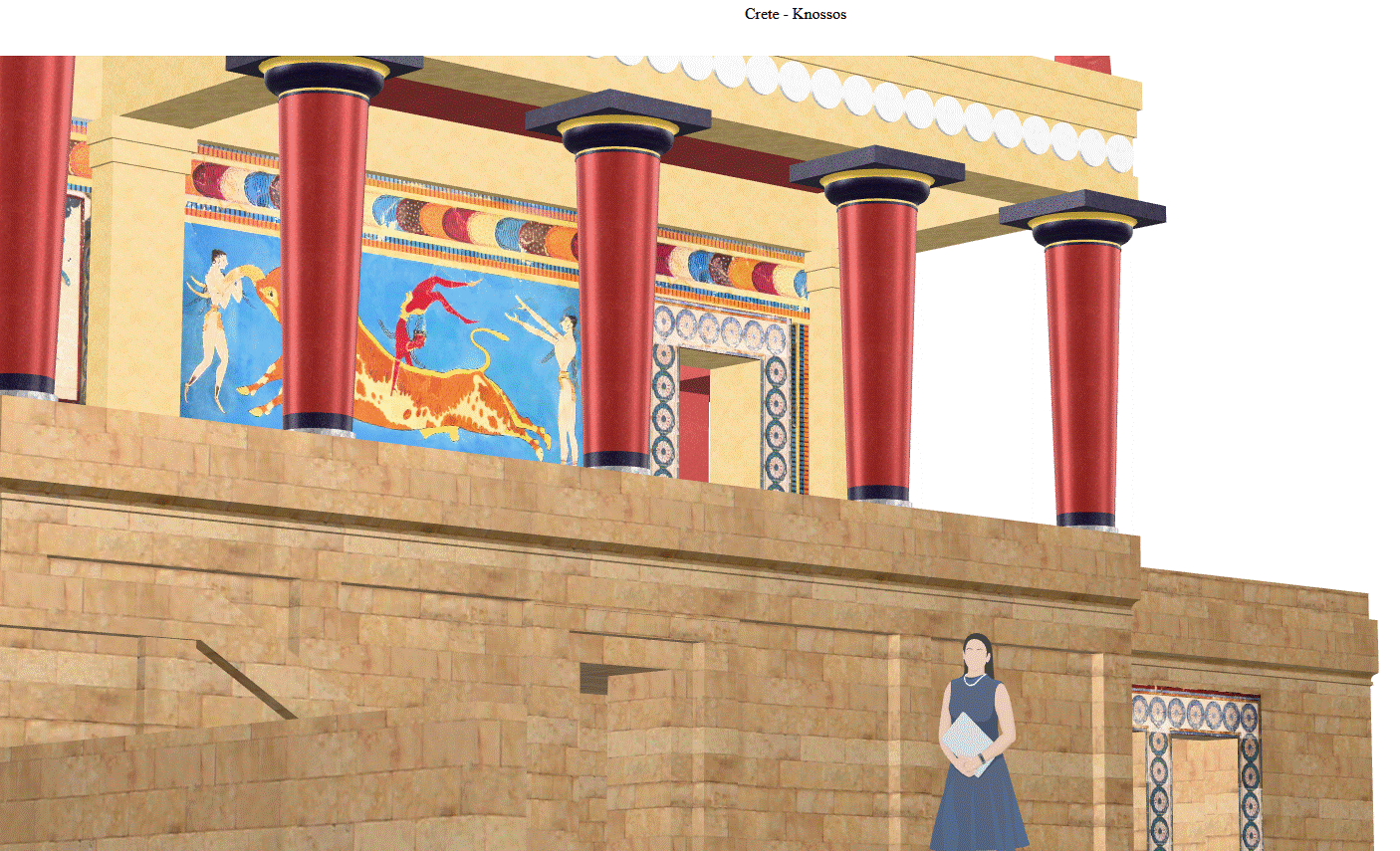
Goddesses of the Louvre Museum - Part 1 - PrehistoricIf entire video does not play, visit YouTube to finish viewing. Goddesses of the Louvre Museum - Part 2 - Historic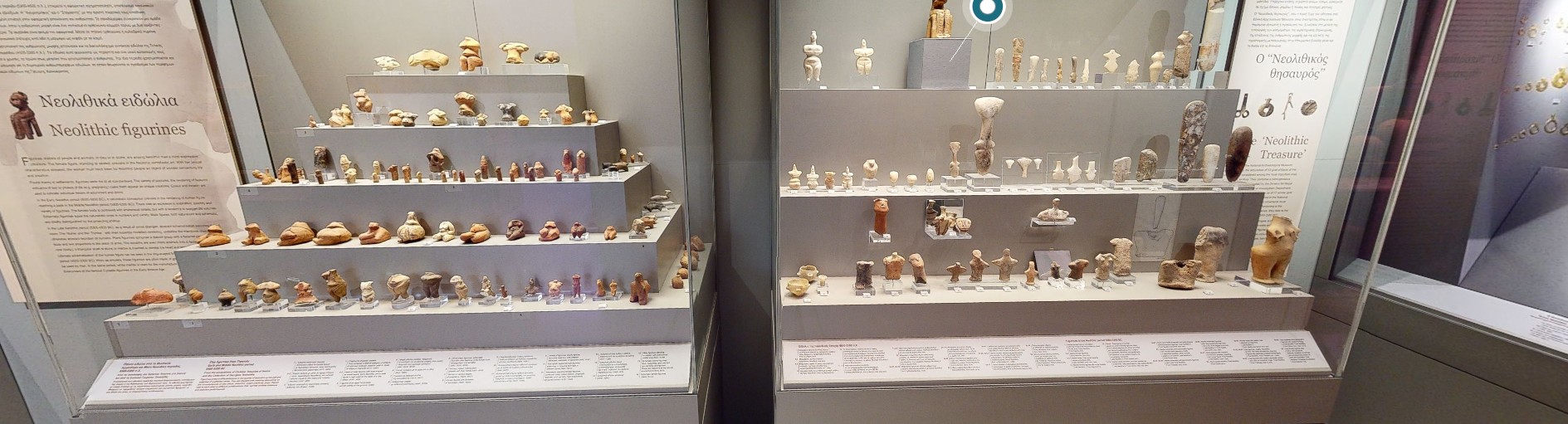
COMING SOON: Our video from the National Archaeological Museum of Athens. Meanwhile have a virtual look around the museum. A StudioinaStudio site. |